Stinging Insect Control in Farmersville, TX
Wasp, hornet, and yellow jacket nests near doorways, decks, and play areas are hazards that get worse all season. Eco First Pest Control connects homeowners in and around Farmersville with professionals who remove nests safely — including the hidden wall-void and ground nests that send people to the ER.
Species identification drives everything: paper wasps, yellow jackets, bald-faced hornets, mud daubers, and bees each require different approaches — and honey bees are referred for relocation rather than extermination whenever possible.
Why Farmersville Homes Deal With Stinging Insect Control
Texas has long, hot summers and short, mild winters — ideal conditions for pests. Paper wasps and yellow jackets nest around eaves and in wall voids, and red imported fire ants — a stinging hazard in nearly every yard — add ground-level risk.
Wasp colonies peak August through October; fire ants are active most of the year. Even smaller communities like Farmersville see steady pest pressure, and the local pros we work with cover Collin County and the surrounding area.
Common Stinging Insect Situations
Paper wasp nests
Open, umbrella-shaped combs under eaves, railings, and grill covers — modest colonies but quick to defend.
Yellow jacket ground nests
Steady insect traffic in and out of a hole in the lawn or landscape bed — colonies can number in the thousands by August.
Wall-void colonies
Insects streaming into a gap in siding or brick; never seal the hole while active, as the colony will chew into living spaces.
Bald-faced hornet nests
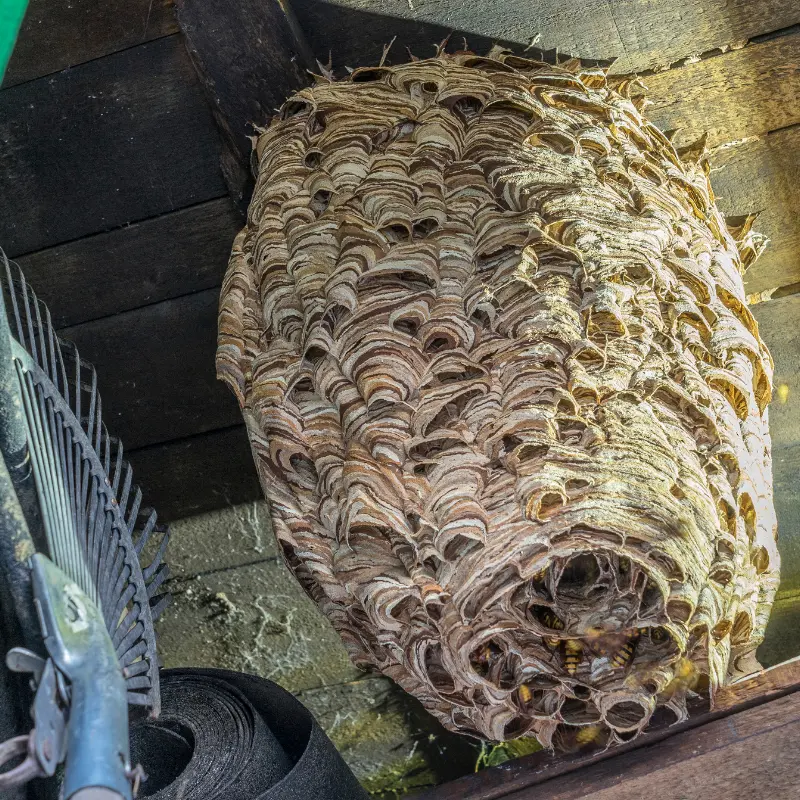
Football-shaped gray paper nests in trees and on structures — highly defensive and best left strictly to professionals.
Carpenter bees
Perfectly round half-inch holes in deck rails, fascia, and siding, with sawdust below.
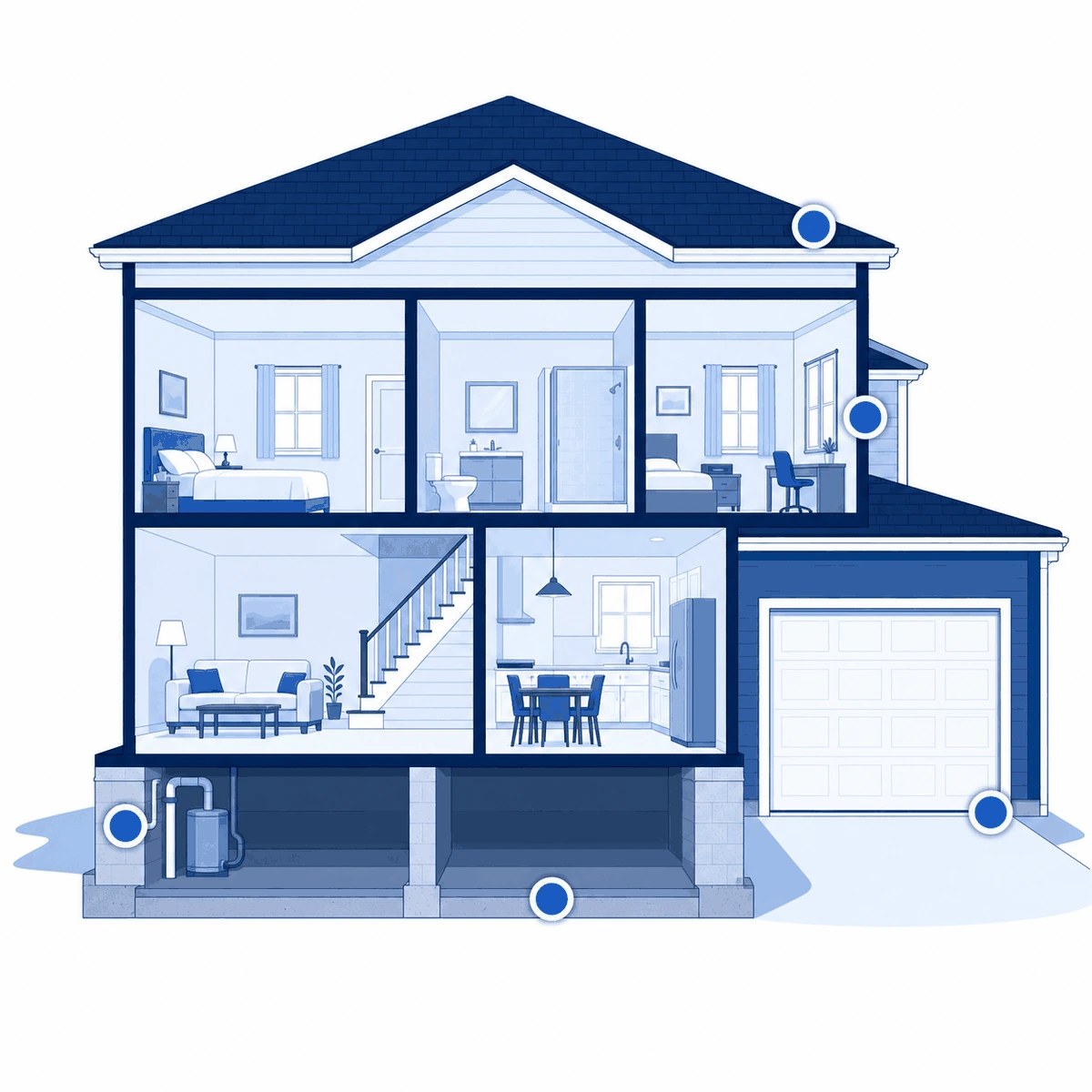
Reducing Stinging Insect Problems
Seal exterior gaps early
Close openings in siding, soffits, and around utility lines in spring before queens choose nest sites.
Manage food and trash
Tight trash lids, cleaned grills, and covered drinks make patios far less attractive to scouting yellow jackets.
Inspect early in the season
Spring nests are golf-ball-sized and easy to handle; the same nest in September can host thousands.
Fill old rodent burrows
Yellow jackets readily colonize abandoned burrows in lawns and beds.
Paint or seal raw wood
Carpenter bees prefer bare, weathered wood — finished surfaces deter drilling.
Stinging Insect Control Timing in Farmersville
Active season
effectively year-round
Peak pressure
late July through September
Wasp and hornet colonies near Farmersville are smallest in spring and largest just before the season ends — nests found late are far more populated, and more defensive, than the same nest in June.
What Stinging Insect Control Costs in Farmersville
$145–$430
per nest removal
Smaller communities often see slightly lower labour rates, though travel time can offset that if the provider is coming from a larger town nearby.
Ranges are typical market estimates, not quotes — final pricing depends on property size, severity and access.
Stinging Insect Control Cost by Treatment Method in Farmersville
| Treatment | Typical cost | Notes |
|---|---|---|
| Accessible nest removal | $145–$335 | Exposed nest under an eave or on a railing. |
| Wall void or height access nest | $240–$570 | More involved and higher risk; may require opening the void. |
| Ground nest (yellow jackets) | $190–$430 | Aggressive colonies. Not a DIY job. |
| Honey bee live relocation | $285–$1,140 | Includes cutting out and removing comb. Leaving comb behind causes damage and secondary pests. |
| Comb removal and repair | $475–$2,375 | Where a colony has been established in a wall for some time. |
| Preventive perimeter treatment | $95–$240 | Applied in spring to deter nest building at known sites. |
Cost by Property Size in Farmersville
| Property size | Typical range |
|---|---|
| Under 1,000 sq ft | $115–$270 |
| 1,000 – 2,000 sq ft | $145–$335 |
| 2,000 – 3,000 sq ft | $175–$400 |
| 3,000 – 4,000 sq ft | $195–$450 |
| Over 4,000 sq ft | $225–$520 |
Typical market ranges for Farmersville, not quotes. Access, construction type and severity all move the final figure.
What a Fair Stinging Insect Control Quote Looks Like
Pricing in this trade varies widely for the same job, and most of that variation is not the treatment — it is what gets bundled, warrantied or upsold around it. Here is what a straightforward quote in Farmersville should contain, and what should give you pause.
A quote should include
- A written inspection finding — what was found, where, and which species
- The specific treatment proposed and why it suits that species
- What is and is not covered, in writing
- Follow-up visits: how many, when, and whether they are included in the price
- Preparation instructions before the visit
- The technician’s licence number and proof of insurance
- Any guarantee period, and precisely what triggers a free re-treatment
What should give you pause
A price quoted before inspection
Property size, access and severity all move the figure. A phone quote is an anchor, not a commitment.
Annual contracts with no cancellation terms
Read the cancellation clause before signing. Auto-renewal with a penalty is common and easy to miss.
Vague "we use safe products"
Ask which EPA-registered product, applied where, and what the re-entry interval is. A professional will answer without hesitating.
No follow-up included
Most infestations need a second visit to break the life cycle. If follow-up is charged separately, factor it into the comparison.
No licence or insurance offered
Every state licenses pest control operators. A provider who will not show a licence number is not one to use.
If a quote is materially above the ranges above, that is not automatically wrong — access, construction and severity genuinely move the figure. But it does mean the provider should be able to explain exactly what accounts for the difference.
Stinging Insect Control Cost Calculator for Farmersville, TX
Estimate what stinging insect control is likely to cost on your property. The starting range reflects local Farmersville market rates; property size and how far the problem has progressed adjust it from there.
Estimated cost in Farmersville
$145 – $430
per nest removal
Most providers quote after an inspection, since access and extent change the figure more than property size alone.
Get an exact quote: +1 855 774 7802Estimates only, not a quote. Figures are based on typical Farmersville market rates and adjust for property size and severity. Access, construction type and the specific pest all affect final pricing, which is why providers quote after inspection.
Wasp and hornet Activity Calendar for Farmersville
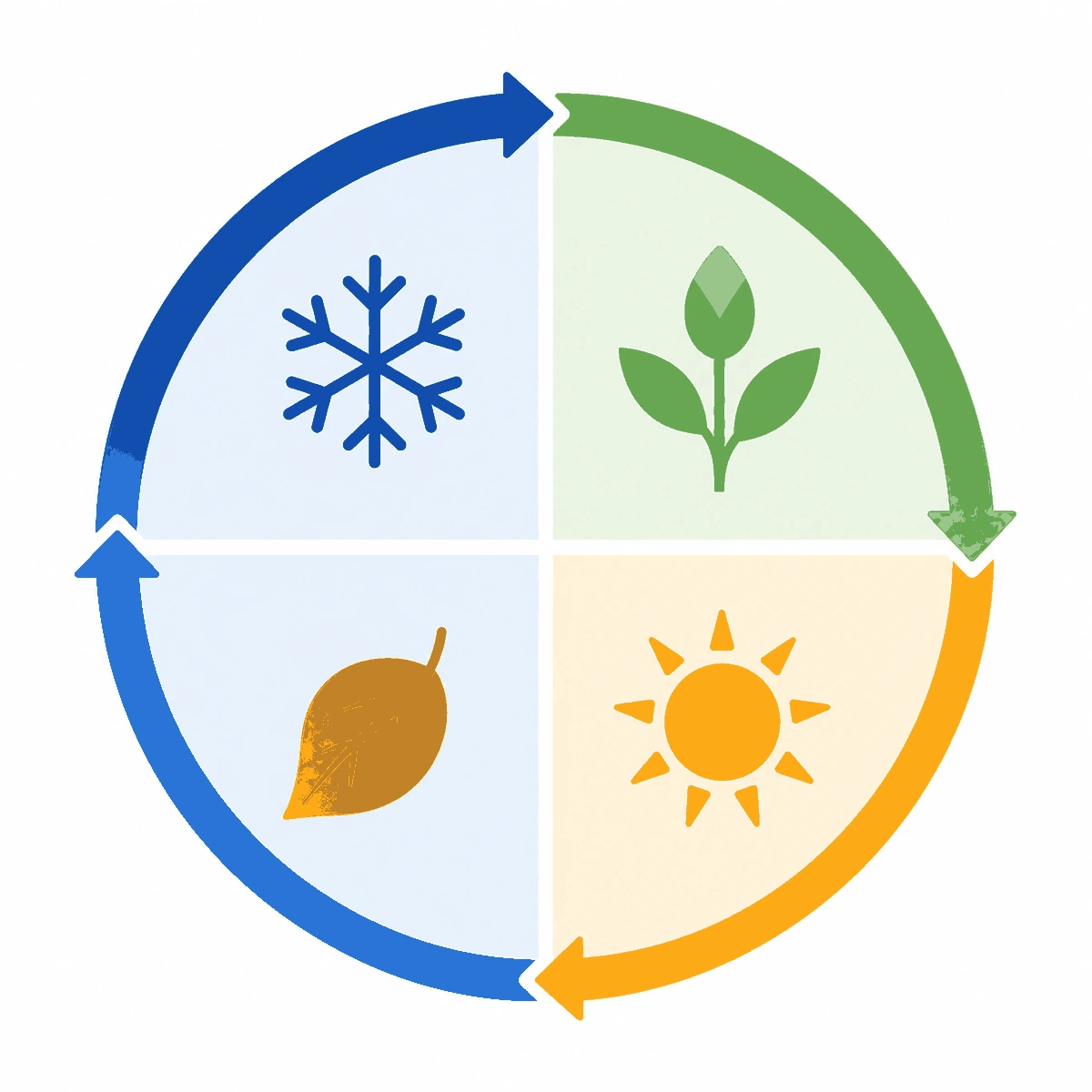
Activity levels below are derived from Farmersville's measured monthly temperature normals. Insect development effectively stops below about 50°F and accelerates above 75°F, so the local temperature curve sets the calendar.
| Month | Avg temp | Activity |
|---|---|---|
| January | 45°F | Low |
| February | 49°F | Low |
| March | 57°F | Moderate |
| April | 64°F | Moderate |
| May | 73°F | High |
| June | 81°F | Peak |
| July | 85°F | Peak |
| August | 85°F | Peak |
| September | 77°F | Peak |
| October | 66°F | High |
| November | 55°F | Moderate |
| December | 47°F | Low |
Farmersville never drops into a dormant month, so wasp and hornet activity continues year-round, peaking in June through September. That is why continuous prevention outperforms one-off seasonal treatment in this market.
Monthly temperature normals: NOAA 1991–2020.
Farmersville Climate and Pest Activity
Average July high
95°F
Average January low
34°F
Months above 80°F
5 of 12
Frost-free months
12 of 12
Annual precipitation
38.3"
Measured against the 1991–2020 normals, Farmersville sees 5 months above 80°F, peaks around 95°F in July and drops to roughly 34°F in January.
Wasp and hornet colonies build through the season from a single overwintered queen. With 12 frost-free months here, colonies near Farmersville have roughly 52 weeks to develop, which is why nests found late in the season are dramatically larger and more defensive than the same nest in early summer.
Figures are 1991–2020 climate normals from the NOAA station at Mckinney Muni Ap, 13 miles away.
Farmersville Housing and Pest Risk
Housing units
1,456
Built before 1960
36%
Single-family detached
93%
Owner-occupied
72%
Built since 2010
18%
Census figures put Farmersville's housing stock at roughly 1,456 units, with 36% predating 1960 and 18% built since 2010.
The age of that stock is relevant to general pest control. Older homes typically have more gaps at the foundation, around utility penetrations and beneath doors, along with crawl spaces and basements that provide sheltered harbourage. Exclusion work usually pays back faster than repeat treatment in housing of this age.
Median home value locally is around $273,600, which is worth weighing against treatment cost — particularly for termite work, where an untreated colony can cause damage running to many thousands of dollars and is excluded from virtually every homeowner policy.
Housing figures: US Census Bureau, American Community Survey 5-year estimates (2023).
Local Conditions in Farmersville, TX
Farmersville is a smaller community of about 3,708 residents, and most providers here cover Collin as a single service area rather than the town alone.
Serving roughly 3,708 residents across Collin, providers here plan routes around travel distance, which affects how quickly a follow-up visit can be scheduled.
What Happens on the Visit
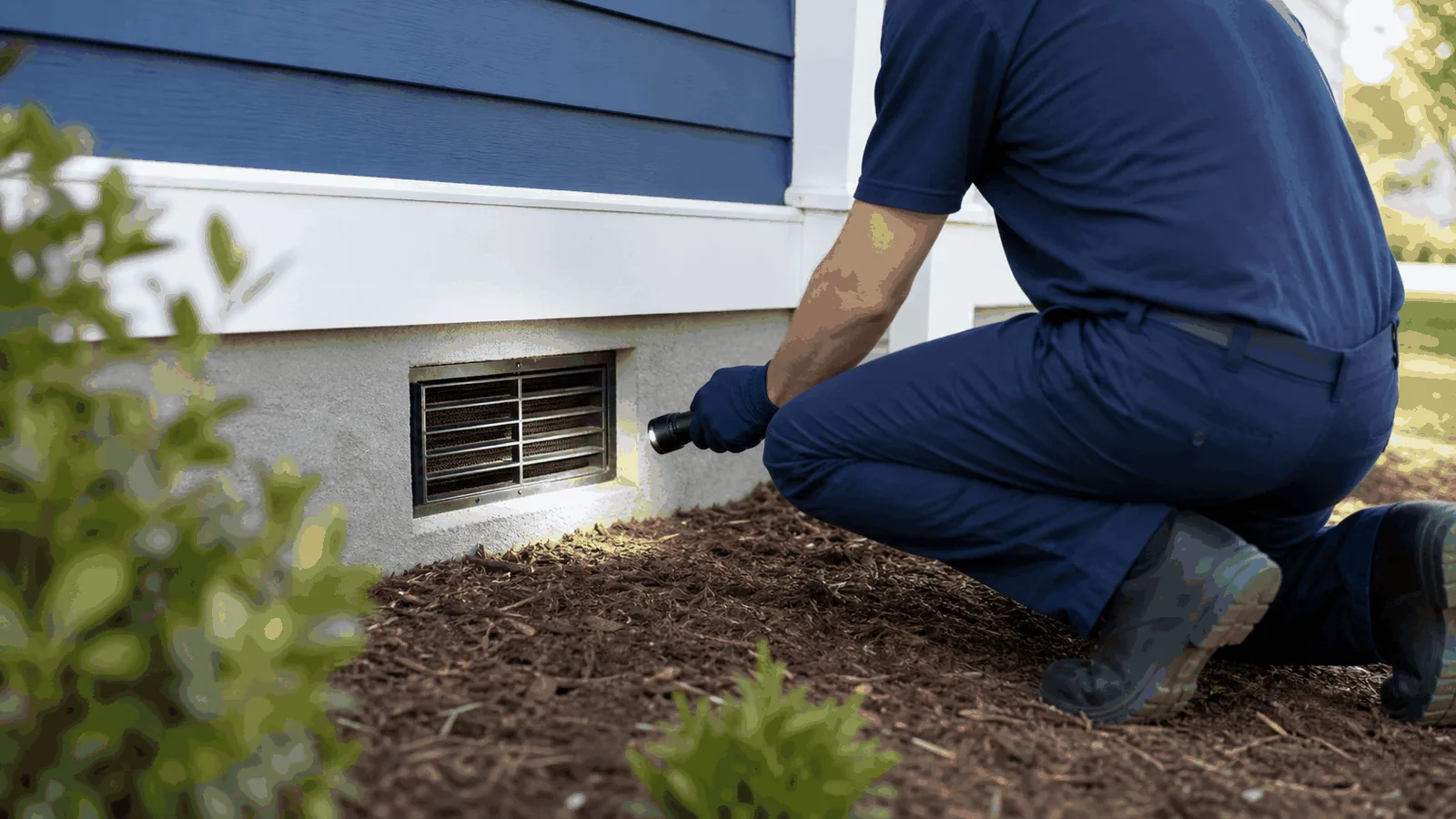
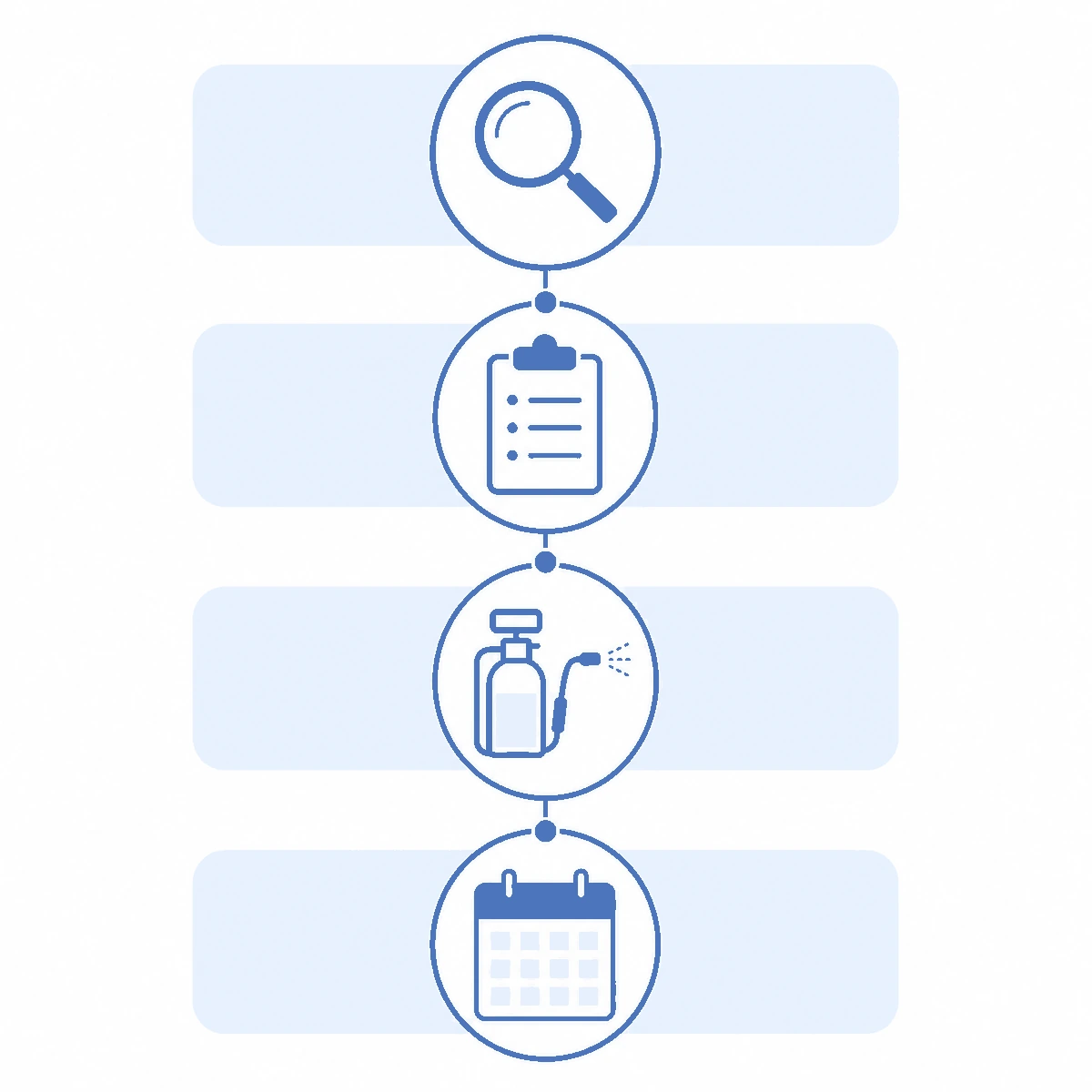
Locate and identify
Wasp, hornet, yellow jacket and honey bee nests each call for a different approach — honey bees are usually relocated rather than destroyed.
Timed treatment
Nests are treated at dawn or dusk when the colony is inside and least active, which is both safer and more effective.
Nest removal
Where accessible, the nest is physically removed so it does not attract secondary pests as it decays.
Prevention
Likely re-nesting sites — soffits, eaves, wall voids and ground cavities — are identified and sealed where practical.
Providers serving Farmersville often cover a wide rural area, so booking a day or two ahead gets a better time slot — urgent calls are still handled quickly.
How It Works in Farmersville
Getting help through Eco First Pest Control is straightforward — one call, and a local professional takes it from there.

Call and describe the problem
Call +1 855 774 7802 and tell us what you're seeing, where, and for how long. It takes a couple of minutes.
Get matched with a local pro
We connect you with a licensed exterminator who covers your neighborhood and handles your specific pest.
Species and nest assessment
The technician identifies the species and locates the nest — including concealed nests in walls, attics, and ground cavities.
Protected nest treatment
Using proper protective equipment and professional products, the technician treats and (where accessible) removes the nest, timed for maximum colony impact.
Prevention guidance
You'll get specific recommendations — sealing, attractant management — to reduce the odds of a new colony next season.
Stinging Insect Control FAQs for Farmersville, TX
Can I just spray the nest myself at night?
Retail sprays can work on small, open, reachable paper wasp nests — but misjudging yellow jackets, hornets, or void nests causes serious sting incidents every year. Anyone with sting allergies should never attempt it.
Yellow jackets are coming out of my wall — what now?
Do not plug the hole — trapped colonies chew through drywall into the house. Keep people away from the entrance and call +1 855 774 7802; void colonies need professional treatment before sealing.
Do you remove honey bees?
Honey bee situations are referred to relocation specialists or beekeepers whenever feasible — extermination is the last resort for protected, beneficial pollinators.
Will the nest come back next year?
Old nests aren't reused, but attractive sites get re-selected by new queens each spring. Treatment plus the prevention steps your technician recommends breaks the pattern.
Are fire ants treated like wasps?
No — fire ant control uses broadcast baits and mound treatments, while wasps and yellow jackets require nest location and direct treatment. Many providers bundle both for full-yard sting protection.
How much does stinging insect control cost in Farmersville?
Most Farmersville homeowners pay roughly $145–$430 per nest removal. Smaller communities often see slightly lower labour rates, though travel time can offset that if the provider is coming from a larger town nearby. Call +1 855 774 7802 for a quote on your specific property.
Do I need one-time or recurring service in Farmersville?
With Farmersville staying frost-free for most of the year, pest pressure here barely pauses, and recurring quarterly service generally outperforms one-off treatment. A single visit still makes sense for a specific problem such as a wasp nest.
When is stinging insect control most needed in Farmersville?
Effectively year-round, peaking late July through September. Wasp and hornet colonies near Farmersville are smallest in spring and largest just before the season ends — nests found late are far more populated, and more defensive, than the same nest in June.
How quickly can someone come out in Farmersville?
Providers serving Farmersville often cover a wide rural area, so booking a day or two ahead gets a better time slot — urgent calls are still handled quickly.
Does winter in Farmersville kill off wasps and hornets?
Only partially. Farmersville's January low averages 34°F, which suppresses outdoor activity without eliminating populations. Survivors overwinter in wall voids, crawl spaces and insulation, then re-emerge as temperatures climb in spring.
What time of year should I book stinging insect control in Farmersville?
Farmersville is frost-free for roughly 12 months of the year, so there is no true off-season and treatment can begin whenever the problem appears. Booking before the spring build-up gives the best result and the widest choice of appointment times.
Why do wasps and hornets seem worse some summers in Farmersville?
Development speed tracks temperature. Farmersville averages a July high of 95°F across 5 months above 80°F, and in hotter-than-normal years the egg-to-adult cycle shortens — so more generations complete in the same season. That is why a warm spring often produces a noticeably worse summer, and why treatment timing matters more than treatment volume.
Get Stinging Insect Control in Farmersville Today
Stinging insect colonies only grow more aggressive as the season progresses. Get a professional on it in Farmersville, TX — usually within a day or two.
Connect with a trusted pest control expert near Farmersville